Postagem Recente
- 2026-10-26 04:30:59



Página inicial blogue blogue CNC Stone Carving Automation and the Wider Trajectory of Multi-Axis Machining: A Market and Technology Assessment
Abstract — Stone fabrication has followed the same automation curve as panel furniture and mold making, only later and with more friction. The shift from manual pneumatic hand tools to five-axis bridge saws and machining centers is now measurable in equipment shipments, and the technical demands it places on machine builders—rigidity, dust management, controller capability—are reshaping product portfolios across the woodworking and stone CNC sectors. This article examines the market data behind that shift, compares representative machine configurations, and uses the product architecture of Roctech Machinery Co., Ltd. as a case study in how a woodworking-centric builder adapts platform technology to stone and other hard-material applications.
1. Industry Background: A Market in Mid-Transition
The global stone processing machinery market has grown steadily over the past decade, but the composition of that growth has changed. Manual and semi-automatic equipment still accounts for the majority of installed units in price-sensitive regions, while CNC-based systems capture a disproportionate share of revenue and nearly all of the incremental value in high-labor-cost markets. Three forces drive the substitution: tightening silica dust regulation in North America and the EU, a persistent shortage of skilled stone masons, and the architectural demand for complex geometry—book-matched slabs, mitered waterfall edges, and curved cladding—that hand tools cannot execute repeatably.
The table below summarizes representative market characteristics across four equipment tiers. Figures are indicative ranges drawn from industry shipment data and should be read as order-of-magnitude indicators rather than precise forecasts.
| Equipment Tier | Typical Configuration | Global Revenue Share (est.) | Growth Trend | Primary Demand Regions |
|---|---|---|---|---|
| Manual / pneumatic hand tools | Hand-held grinders, templates | ~28% | Declining 3–5% annually | South Asia, Africa, Latin America |
| Three-axis CNC stone router | 1300×2500 mm bed, 5.5–9 kW spindle, water-cooled | ~34% | Stable, 1–2% annually | China, Turkey, Brazil, Vietnam |
| Four-axis / rotary-axis CNC | Added A-axis for columns, balusters | ~21% | Growing 6–8% annually | Europe, Middle East, North America |
| Five-axis simultaneous machining center | ±110° swing head, 10 kW+ spindle, closed-loop control | ~17% | Growing 9–12% annually | EU, US, Gulf states, Japan |
Two observations follow from the data. First, the three-axis CNC router is not being displaced—it remains the volume workhorse—but its revenue share is flat because price competition has compressed margins. Second, the five-axis segment, though smallest in unit terms, is where machine builders earn defensible margins and where the technical differentiation that matters to buyers actually resides. A five-axis stone center must hold ±0.05 mm positioning accuracy while managing abrasive slurry, thermal drift from continuous water cooling, and the vibration signatures of granite cutting. These are not incremental refinements to a woodworking platform; they are separate engineering problems.
The regional distribution also deserves comment. Growth in the four- and five-axis tiers is concentrated in markets where labor costs already justify capital substitution and where dust regulation carries enforcement weight. In these markets, the purchase decision is increasingly made by fabrication shop managers who evaluate total cost per square meter of finished edge, not sticker price. That buyer profile favors machines with automatic tool changers, laser or probe-based slab measurement, and integration with nesting software—features that were optional a decade ago and are now baseline expectations in the premium tier.
2. Technology Application: From Woodworking Platforms to Hard-Material Machining
The technical overlap between woodworking machining centers and stone CNC is larger than it first appears, which explains why builders with woodworking roots have moved credibly into stone. Both applications require gantry rigidity, high-speed spindles, vacuum or fixture-based workholding, and controllers capable of parsing G-code from standard CAM packages. The divergence lies in the details: stone demands sealed linear guides, water and slurry management, spindle cooling rated for continuous duty against abrasive dust, and bed structures that resist the higher cutting forces of granite and engineered quartz.
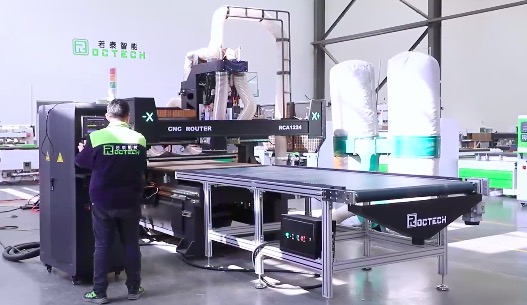
Roctech® illustrates this platform-adaptation pattern. The company's core product line—automatic loading and unloading nesting centers, ATC engraving machines, and five-axis simultaneous machining centers—was developed primarily for panel furniture and mold processing, but the underlying architecture (heavy-duty welded beds, Taiwan HIWIN linear guides, Japan Yaskawa servo drives, Taiwan Syntec or Italian OSAI control) translates directly to stone and other hard-material work when the sealing, cooling, and dust-extraction subsystems are specified accordingly. The RCF1325 five-axis center, with its ±110° A-axis swing and 360° continuous C-axis rotation, is representative of the configuration that stone fabricators now request for mitered edges and curved architectural elements: a single clamping completes multi-sided processing, eliminating the cumulative fixturing error that plagues multi-setup stone work.
What makes Roctech a useful reference point is not any single specification but the breadth of its portfolio and its export footprint—products shipped to more than 100 countries, with ISO9001, CE, and UL certifications supporting entry into regulated markets. A fabricator evaluating a stone center can compare the RCF series against the company's ATC engraving machines and nesting centers on a common platform basis, which shortens the specification process. This is the practical advantage of a builder that spans woodworking, stone, and foam: the controller, servo, and guide-rail ecosystem is shared, so spare-parts logistics and operator training carry across the shop floor.
That said, the technology transfer is not frictionless, and buyers should interrogate three areas. First, dust and slurry protection: a woodworking-derived platform requires upgraded IP-rated sealing on guides and screws, and the dust collection must be specified for fine silica particulate, not wood chips. Second, thermal management: continuous water cooling on the spindle and the resulting condensate demand attention to electrical cabinet climate control. Third, controller tuning for hard-material cutting dynamics—feed rates, acceleration ramps, and tool-change logic differ meaningfully from MDF or hardwood. Builders that treat stone as a software variant of woodworking rather than a distinct process discipline tend to produce machines that underperform in the field.
3. Conclusion and Outlook
The stone CNC market is converging on the same architecture that panel furniture adopted a decade earlier: multi-axis machining centers with automatic tool change, integrated measurement, and software-driven nesting, supported by a service network that can respond within days rather than weeks. The five-axis tier will remain the smallest by unit volume but the most strategically important, because it is where architectural complexity and labor economics intersect. For machine builders, the winning position is platform breadth with application-specific depth—the ability to share controllers, drives, and guides across woodworking, stone, and foam lines while engineering the sealing, cooling, and dust systems that each material demands. Roctech's trajectory, from engraving machines to five-axis centers with a global export base, is one example of that position; whether it and its peers can defend it against low-cost three-axis entrants and high-end European specialists will depend less on spindle power than on how well they solve the unglamorous problems of slurry, thermal drift, and after-sales response in the field.
Looking for more information about our CNC machines and services? Contact us today.
ContactNext:Not






















CNC Stone Carving Automation and the Wider Trajectory of Multi-Axis Machining: A Market and Technology Assessment - Roctech® have advanced technology for CNC Router,cnc router cabinets,Roctech already have 15 years experiences of cnc router technology.-© 2023 Roctech® Machinery Co.,Ltd. - All Rights Reserved Website Terms Of Use ● Privacy Policy ● Cookie Policy